

The purpose of management education is to up-skill business leaders and prepare them for their next role in an organisation.
The main issue with management education programmes is that they provide a wrong picture of what management is and are disconnected from the realities of organisational workings.
The “what” of MBA education is clear and most MBA curricula are aligned with the accreditation and business standards, i.e. they address what is required. The “how” is however more fluid and cannot be fully differentiated across programmes. In the world where any skill can be learned through a variety of online resources, MBA programmes are subject to increasing scrutiny over their real added value. Some even assimilate MBA programmes to networking events where the only real added value are the personal connections students acquire.
“How” MBA programmes are thought is becoming a key differentiation versus other forms of managerial development and provide an opportunity to make MBA relevant again in the corporate world.
The action learning pedagogy
One of the main critiques of MBA education is related to the disconnect between the classroom and the organisational realities. Rather than connecting these two environments with the force of a business institution, MBA programmes increasingly move away with the sole use caste studies, irrelevant examples and remote locations for learning. Students learn analysis, but not action. They develop skill in attacking problems but learn little about implementing them.
Students learn analysis, but not action.
Action learning as a pedagogy holds much promise for closing the disconnect between the classroom and the working environment, but also bridges the gap between “knowing” and “doing”. Action-based learning enriches business education by effectively connecting theory and practice. It deepens understanding of analytical concepts and tools, builds confidence in their use, and hones skills essential for their successful application.
Executive School of Economics and Management, ESEM has created a new pedagogical method with an aim to address these challenges. ESEM is a brand new business school that caters to the up-skilling of managers and young leaders of developing markets, starting with in the region of South East Europe. ESEM has created a novel pedagogical concept, the ESEM Method, that improves on active experiential learning and action-reflection pedagogy, fundamentally shifting the focus from teaching to learning. Participants benefit from the dedicated mentoring, personalised experience, collaborative learning, cross-functional approach, blended learning format and guided reflection.
The ESEM Method is a cycle of learning, doing and reflecting with committed mentoring throughout. Effectively, the action learning method amplifies learning through application and reflection. Each programme at ESEM is designed to integrate action learning at its core.
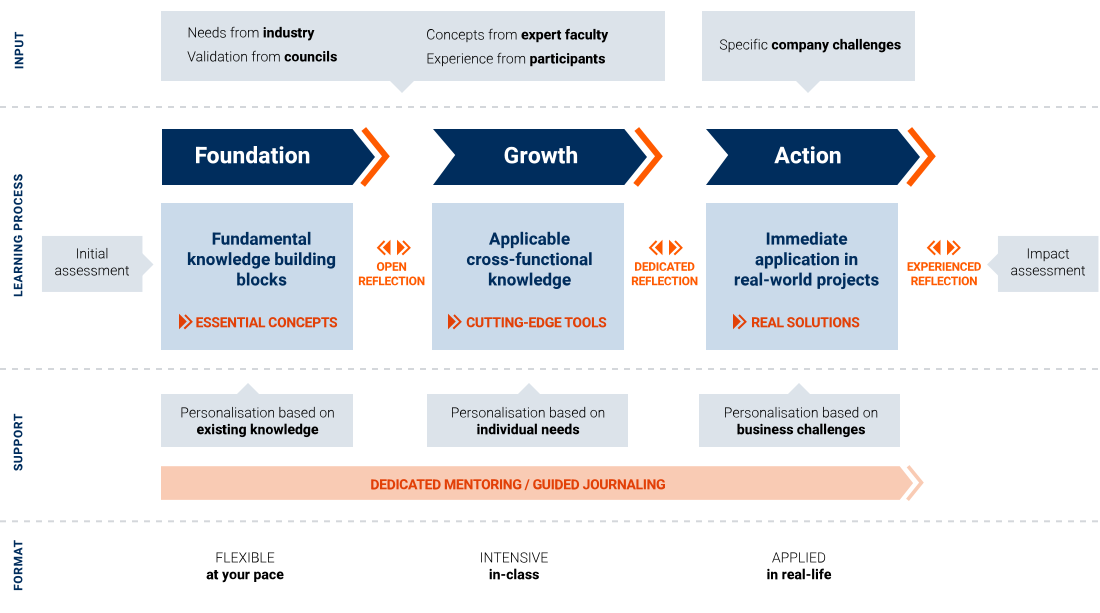
Feeding on the concerns about the value added by MBA education, there is growing consensus about changes needed to make programmes more relevant. The following topics are identified as the unmet needs of MBA programmes worldwide, and especially locally in Serbia with most business schools based in Belgrade.
Leadership development
Most MBA programmes emphasise analytical frameworks and quantitative techniques, not softer, hard-to-measure organisational skills. Technical knowledge can be found on the job, in online resources, through corporate educational programmes, while soft skills require individual attention, mentoring and coaching.
Moreover, most of the business schools aspire to train and develop leaders, yet their efforts in this area are widely viewed as falling short. Leadership skills are generally covered in one or a few modules of MBA programmes and fail to address the different needs from self-awareness to inspiring, influencing, guiding, and communicating effectively.
Inspired by the most comprehensive leadership programmes in the world, ESEM has developed a unique leadership journey that covers the full scope of competencies required for effective leadership. It spans across the entire Executive MBA journey and is structured within 5 carefully designed modules delivered by a global network of leadership experts.
Integration skills
Business schools have organised their faculties and courses by function and rarely these functions connect each other. Apart from a capstone project that spans across several disciplines, modules are structured in silos and do not provide a real cross-functional view of the realities of each organisation.
At ESEM, the ability to tackle business issues from multiple functional perspectives is a key outcome of the cross-functional approach embedded across all formats of the learning journey.
Creative and innovative thinking

Even thought MBA students are well trained analytically, they still lack essential innovative thinking skill that are rarely covered in MBA curricula. Faced with a clearly defined, targeted problem, MBA students are ready to apply spreadsheets, decision trees and financial models. But faced with unstructured problems, ambiguous data and changing environments, MBA students are less likely to be effective. Lectures and case studies provide only limited training in this skills.
ESEM is the new hub for researchers and practitioners in the domain of decision making and have created a specialised center at the school: “ESEM Thinking Labs”. Furthermore, within the Executive MBA programme the module that covers Decision Making deals with problem solving techniques, as well as Analytical, Critical, Creative and Design thinking. Students learn how to deal with the weight of decision making and to apply the discipline for appropriate scrutiny, integrate knowledge, handle complexity, to formulate judgements with incomplete or limited information. They become equipped with the concepts and practical tools to deploy versatile approaches suited for different circumstances while they manage complex technical or professional activities or projects that require new strategic approaches, taking responsibility for decision making.
Inspired by these critiques, ESEM has been designed in response to the business education standards challenge.
Deploying The ESEM Method we provide premium, personalised business education experience, grounded in industry needs and real business issues and opportunities. Great teachers, great professionals, all in one place – ESEM – available for you to learn from and learn with.
